Published Pool Removal Prices From California Contractors
California contractors publish $3,500 to $12,000 for a partial fill-in and $8,000 to $30,000 for a full removal in Northern California, while Los Angeles Pool Demolition Contractors starts at $10,500 and $17,500 and Frisch & Sons quotes up to $30,000 or more in Orange County.
Those contractor figures run well above the national cost guides. HomeAdvisor, Fixr and HomeGuide average prices across the whole country, where labour, dump fees and permit costs are lower, so their numbers work best as a floor for California budgets. Every price on this page is attributed to the contractor or guide that published it.
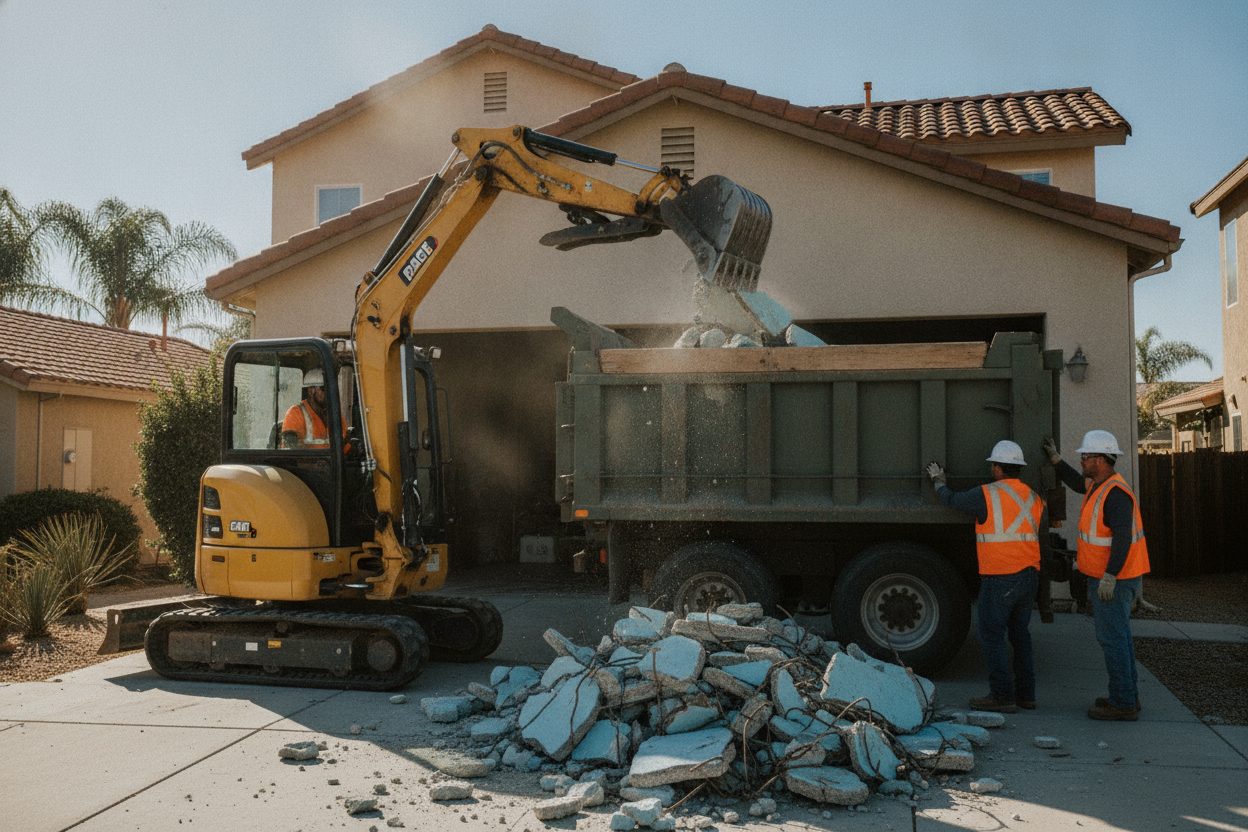
California prices run above the national guides
Three things push California prices up. Labour and equipment rates in the state's metro areas are among the highest in the country. Most California cities require engineering for a full removal, and a compaction report from a soils engineer adds $1,500 to $4,000. Dump fees for concrete and the cost of clean fill dirt are higher near the coast, where most pools are.
Prices also vary sharply within a region. San Diego's two published price lists disagree by a factor of three or more: Demo Diego quotes $9,000 to $15,000 for a full removal, while Villa Demolition quotes $45,000 to $60,000. The gap reflects different pool sizes, access and finish standards, which is why written quotes from more than one licensed contractor are the only reliable guide for a specific pool.
| Source | Area | Partial fill-in | Full removal | Published |
|---|---|---|---|---|
| Angi | Los Angeles | $2,850 to $11,350 | $4,550 to $18,200, average $6,816 | Jun 2026 |
| Frisch & Sons | Orange County | $12,000 to $20,000 | $18,000 to $30,000 or more | 2025 guide |
| Los Angeles Pool Demolition Contractors | Los Angeles | From $10,500 | From $17,500 | Jun 2026 |
| Demo Diego | San Diego | $5,000 to $9,000 | $9,000 to $15,000 | 2026 |
| Villa Demolition | San Diego | $12,000 to $30,000 | $45,000 to $60,000 | Jun 2026 |
| Souza & Son's | Bay Area | $4,500 to $10,000 | $8,000 to $22,000 for a 15 by 30 ft pool | May 2026 |
| Bye Bye Pool | Concord | $3,500 to $7,000 | $9,000 to $19,000 | May 2026 |
| NorCal Earthworks | Sacramento | Not priced | $8,000 to $15,000 concrete, $6,000 to $12,000 fiberglass | May 2026 |
| Walberg, Inc. | Northern California | $5,000 to $12,000 | $12,000 to $30,000 | Aug 2026 |
No source with local prices was found for the Central Valley or the Inland Empire. Owners in Fresno, Bakersfield, Stockton, Modesto, Riverside, San Bernardino and Fontana should start from the Northern California ranges and expect quotes to reflect local labour rates.
Pool removal cost for a partial fill-in against a full removal
A partial fill-in is the cheaper route. A crew breaks drainage holes through the floor, removes the top 12 inches to 2 feet of wall, drops the broken concrete into the shell and fills it with soil. Bye Bye Pool in Concord quotes $3,500 to $7,000 for that work, and Souza & Son's quotes $4,500 to $10,000 across the Bay Area. Most cities limit the area to landscaping afterwards, and some record the shell against the property.
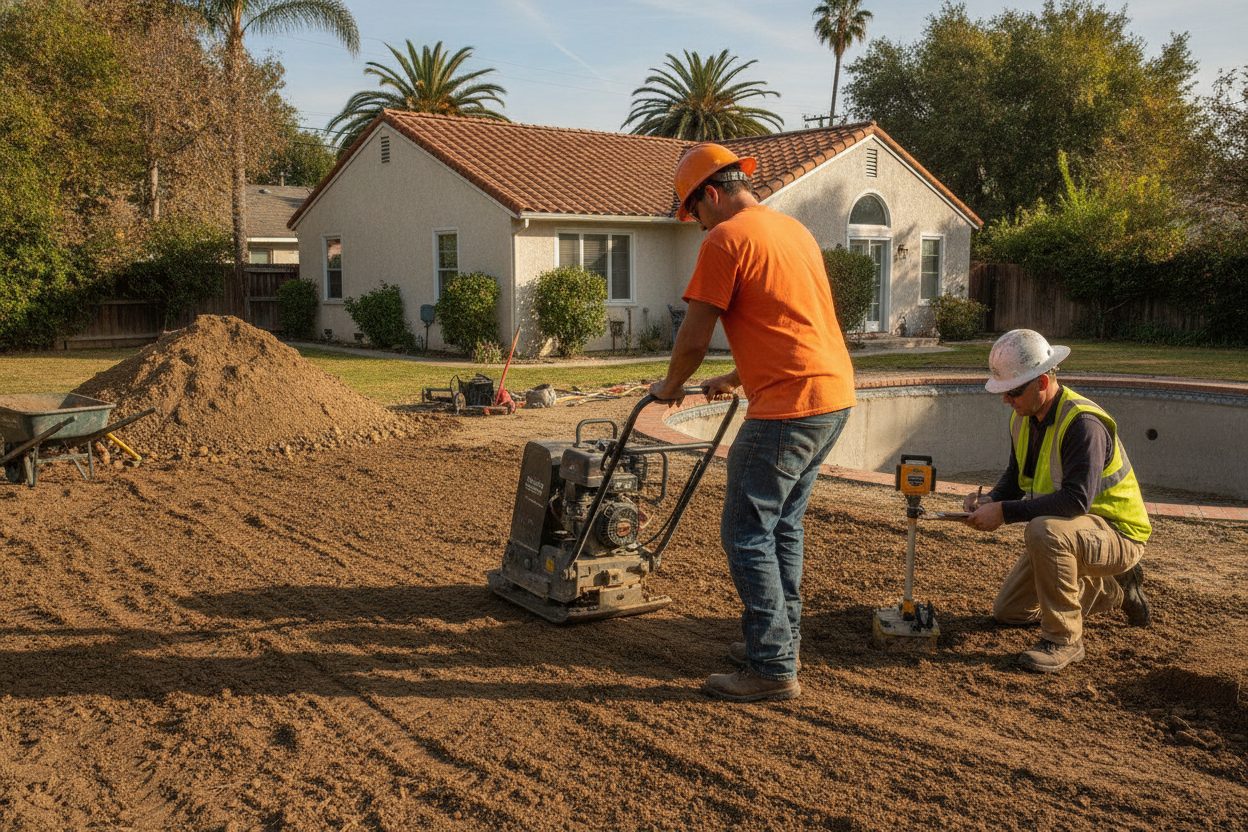
A full removal hauls away the whole shell, then replaces it with fill compacted in layers to 90%. Walberg, Inc. prices that at $12,000 to $30,000 for Northern California, and Angi's Los Angeles figures put the average at $6,816 within a range of $4,550 to $18,200. Full removal costs more in hauling, fill dirt and engineering, but it is the only route that keeps the land buildable for an accessory dwelling unit, an addition or a slab.
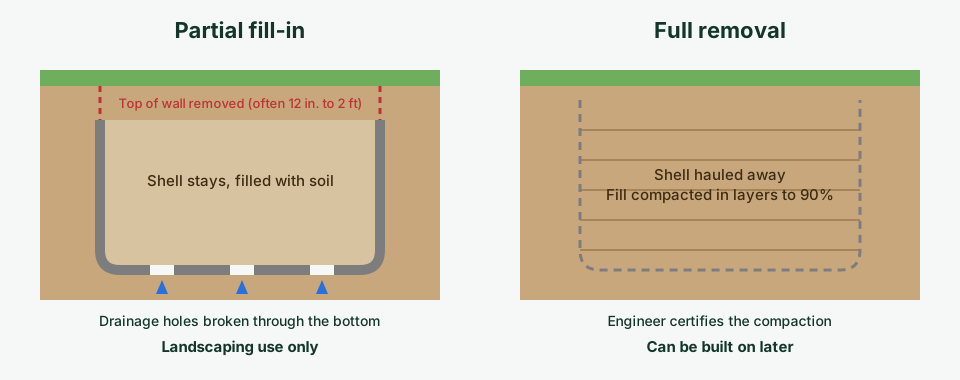
City rules can narrow the gap between the two. Fresno's pool abandonment bulletin requires the entire bottom broken out and all backfill engineered to 90% compaction even when the walls stay, so a Fresno partial job carries most of the cost of a full removal. Riverside's pool demolition handout likewise asks for an engineer's 90% compaction report.
Prices by pool type
Concrete and gunite pools, the most common type in California, cost the most to remove because the shell is thick, reinforced with rebar and heavy to haul. Every contractor price in the table above is for a concrete pool unless it says otherwise.
Fiberglass pools come out in fewer pieces. NorCal Earthworks in Sacramento prices full removal at $6,000 to $12,000 for fiberglass against $8,000 to $15,000 for concrete. Vinyl liner pools, with steel or polymer walls and a sand or grout floor, usually sit between fiberglass and concrete because the walls are lighter but the fill volume is the same.
Above-ground pools are the cheapest. Angi puts removal at $300 to $3,500, with the top of the range reached when a deck surrounds the pool. Above-ground removal rarely needs a demolition or grading permit, though an electrical permit may apply where a dedicated circuit is removed.
Access, decking, fill and engineering move the price
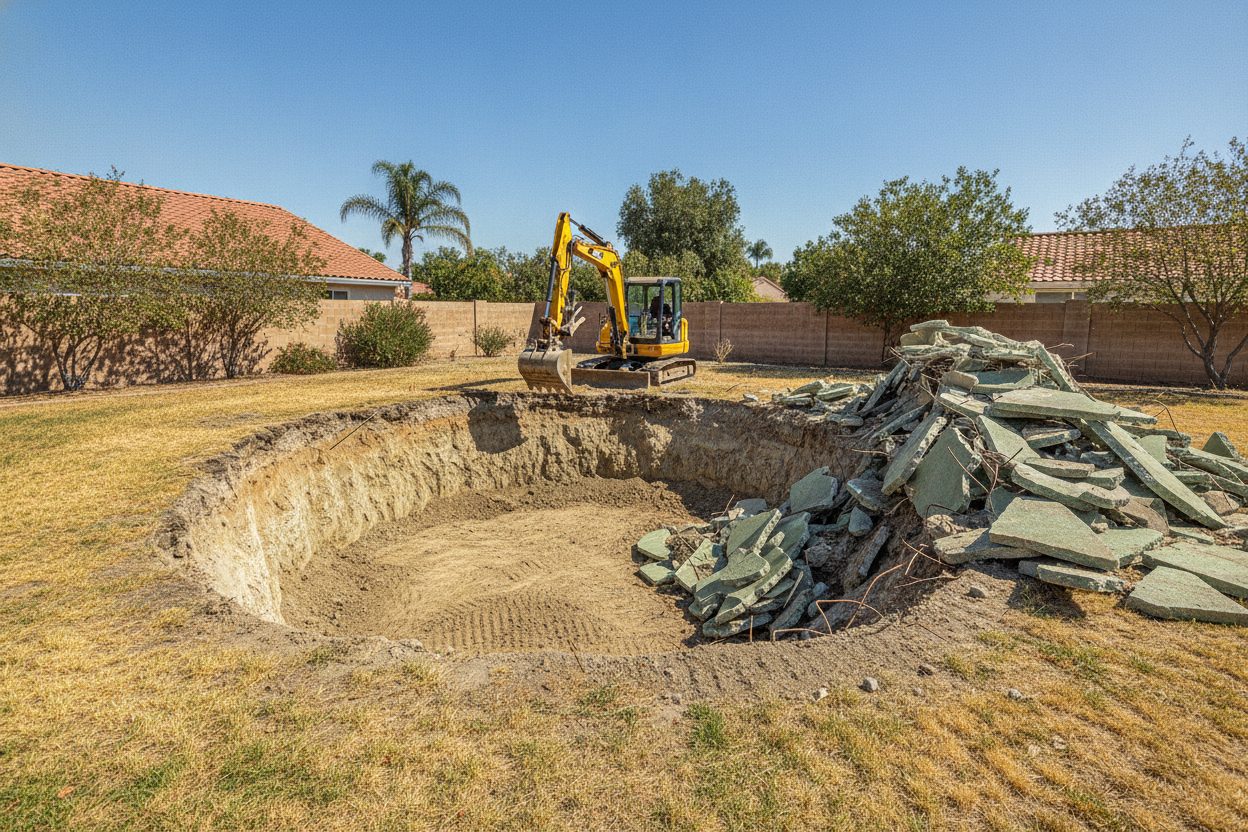
Equipment access is the largest single variable. Contractors add about $2,000 where the side yard is under 6 ft wide, because a smaller excavator or hand labour takes longer and the debris must be carried out in smaller loads. Some jobs need a fence panel removed and replaced, or a crane over the house where no side access exists.
Deck removal adds $500 to $1,700, depending on whether the deck is concrete, pavers or wood and how far it extends past the coping. Many owners keep part of the deck as a patio, which lowers the price and the hauling volume.
Fill dirt is the next large cost. A full removal takes 80 to 150 cubic yards of clean fill, delivered and placed in layers. Clean fill prices vary by county, and a full truckload holds roughly 10 to 14 cubic yards, so a typical full removal needs eight or more truckloads in addition to the loads hauling concrete out.
The compaction report from a soils engineer adds $1,500 to $4,000. San Diego requires a soils compaction report for any pool deeper than five feet under Information Bulletin 710, and Irvine requires a soils engineer to supervise the backfill under its pool removal page. A full removal without that report is rarely accepted as buildable ground.
Utilities make up a smaller line. The pump, filter, heater, lighting and gas lines must be disconnected and capped, which is why Santa Ana requires building, electrical and plumbing permits under handout BLD-16.
Permit fees by city
Permit fees are a small share of the total but vary widely between cities. Stockton charges $97.25 for fiscal year 2026-27 under form BLDG-0014, while San Diego charges $360.36 for plan check plus $332.48 for inspection. San Bernardino bases its fee on the cubic yards of fill, since it treats pool removal as on-site grading. San Jose takes a refundable debris deposit instead of a set pool fee.
| City | Permit | Published fee |
|---|---|---|
| San Diego | Demolition/Removal Permit | $360.36 plan check plus $332.48 inspection (Sept 2026) |
| San Francisco | Demolition permit (form confirmed by DBI) | $724 demolition permit (Table 1A-G, July 2026) |
| Sacramento | Wrecking permit (likely; confirm) | $175 wrecking permit (fee detail effective July 2025) |
| Bakersfield | Unclear | $291 minimum plus project valuation (July 2026) |
| Anaheim | Swimming Pool/Spa Permit (demolition) | $182 demolition, including utility capping (form B712, August 2025) |
| Stockton | Building permit | $97.25 pool demolition, plus technology and other surcharges (FY 2026-27) |
| Riverside | Demolition permit | $125 plus $41 issuance, with a 14% surcharge on issuance (FY 2026-27) |
| Chula Vista | Demolition permit | $404 pool and spa demolition line (September 2024 schedule) |
| Fremont | Express building permit | $266 flat (schedule amended January 2026) |
| Santa Clarita | Building permit (abandonment) | $38 issuance plus $95 for valuation up to $5,000 (FY 2026-27) |
| Modesto | Demolition permit (inferred) | $301 demolition line; $550 pool line (FY 2026-27) |
| Fontana | Demolition permit | $210 per structure (fee list as of 1 January 2026) |
| Moreno Valley | Demolition permit | $153 plan check plus $347 inspection (2026-27, general demolition line) |
| Oxnard | General demolition permit (no pool rule) | $88.20 demolition inspection for swimming pools (July 2026) |
| Huntington Beach | Demolition permit | $41 processing plus valuation-based inspection, from $85 (July 2026) |
| Elk Grove | Demolition permit | $85 pool and spa demolition (July 2026) |
| Lancaster | General demolition permit (no pool rule) | $240 single-family demolition line (schedule effective October 2025) |
| Rancho Cucamonga | Pool demolition permit | $490 residential demolition (FY 2026-27) |
| Oceanside | General demolition permit (no pool rule) | $284.55 general demolition permit (FY 2026-27) |
| Palmdale | General demolition permit (no pool rule) | $222 demolition inspection (FY 2026 schedule) |
Several cities, including Los Angeles, Long Beach, Irvine, Santa Clarita, Santa Ana and Garden Grove, publish rules but no fee line written for pool removal, and 10 cities publish nothing specific to pools. The city pages link each city's own document. Fees for Fresno and Chula Vista come from older schedules and should be confirmed with the city before budgeting.
Timeline from permit to finished grade
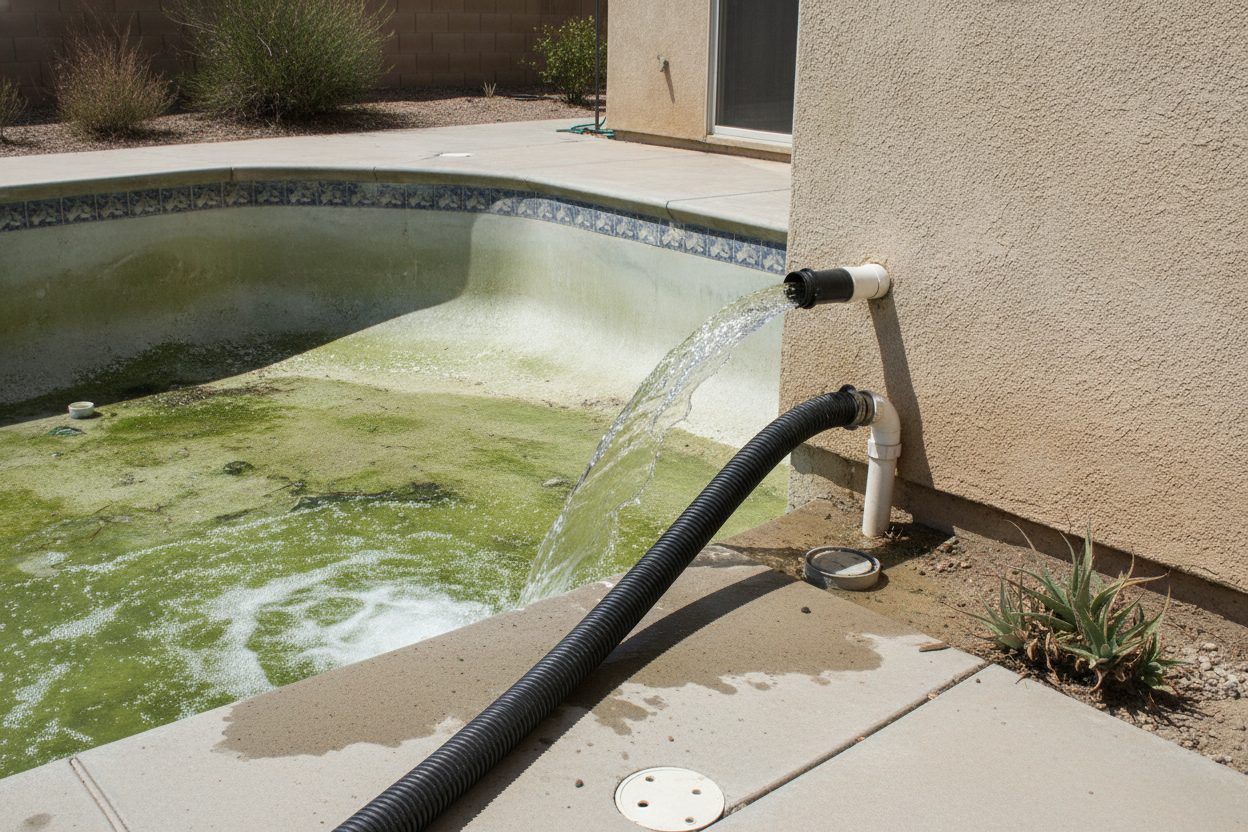
A partial fill-in takes one to four days on site and a full removal three to seven, once the permit is in hand. Draining the pool adds a day or two, and must follow local discharge rules: the San Diego pools and spas fact sheet and LA Sanitation allow the storm drain only for dechlorinated water within a set pH range, and Stockton and Modesto allow the sewer only.
Permits add one to three weeks in most cities. San Jose can issue in a single visit, and Fremont's express permit needs no plan review. San Jose also asks for a job number from the Bay Area Air Quality Management District before demolition, and Oakland bars grading from 15 October to 15 April, so jobs there need to be booked for the dry season.

Property tax and rebates after removal
Removing a pool can lower a property's assessed value. The Board of Equalization's letter 86/09 treats removal of an improvement as a reason to reduce assessed value, and the board's new construction guidance covers how improvements are added and removed. The reduction is tied to the pool's own assessed value, so for a pool built decades ago it may be small. The San Diego County Assessor handles such changes through its realty assessment division; no county publishes a step-by-step process for reporting a removal.
One rebate was confirmed in California. Valley Water in Santa Clara County pays $2 a square foot, up to $3,000, when a pool becomes low-water landscape, and requires approval before work starts. No statewide programme was found.
Regional price notes
Los Angeles County prices start highest among published lists. Los Angeles Pool Demolition Contractors lists $10,500 and $17,500 as starting points, and Angi's Los Angeles range runs from $2,850 for the simplest partial job. Hillside lots in the county often need engineered compaction even for landscaping, which pushes jobs towards the top of the range.
Orange County has the highest published ceiling. Frisch & Sons quotes $12,000 to $20,000 for a partial and $18,000 to $30,000 or more for full removal, and many Orange County homes add homeowners association approval to the timeline.
San Diego County shows the widest spread, from Demo Diego's $9,000 full removal floor to Villa Demolition's $60,000 ceiling. The Bay Area clusters between $3,500 and $12,000 for a partial and $8,000 to $30,000 for full removal across Souza & Son's, Bye Bye Pool and Walberg. Sacramento's one published list, from NorCal Earthworks, sits at $8,000 to $15,000 for a concrete full removal.
Items a written quote should cover
A written quote that lists each item makes two contractors' prices comparable. The scope line should name the method, partial fill-in or full removal, and how much of the wall and floor comes out. The permit line should say who pulls the permit, which permit it is and whether the fee is included. The fill line should give the cubic yards, the source of the fill and the compaction standard, normally 90%.
The engineering line should say whether a soils engineer's compaction report is included, and at what price. Disposal, deck removal, utility disconnection, fence panel removal and final grading each belong on their own line. The quote should also carry the contractor's licence number, which the state licence board lookup confirms, and the workers' compensation policy where the firm has employees.
Payment terms matter too. California limits the down payment on a home improvement contract to 10% of the price or $1,000, whichever is less, and the contract should tie later payments to completed stages such as demolition, fill and final inspection.
About This Site
Pool Removal California is an independent referral directory. The site is not a contractor and does not remove pools. Listed businesses may pay a referral fee when a homeowner is put in touch with them through the site, and that fee never changes the listing order: contractors with an active state licence appear first. The full referral disclosure and listing criteria explain how each business was checked.